The News
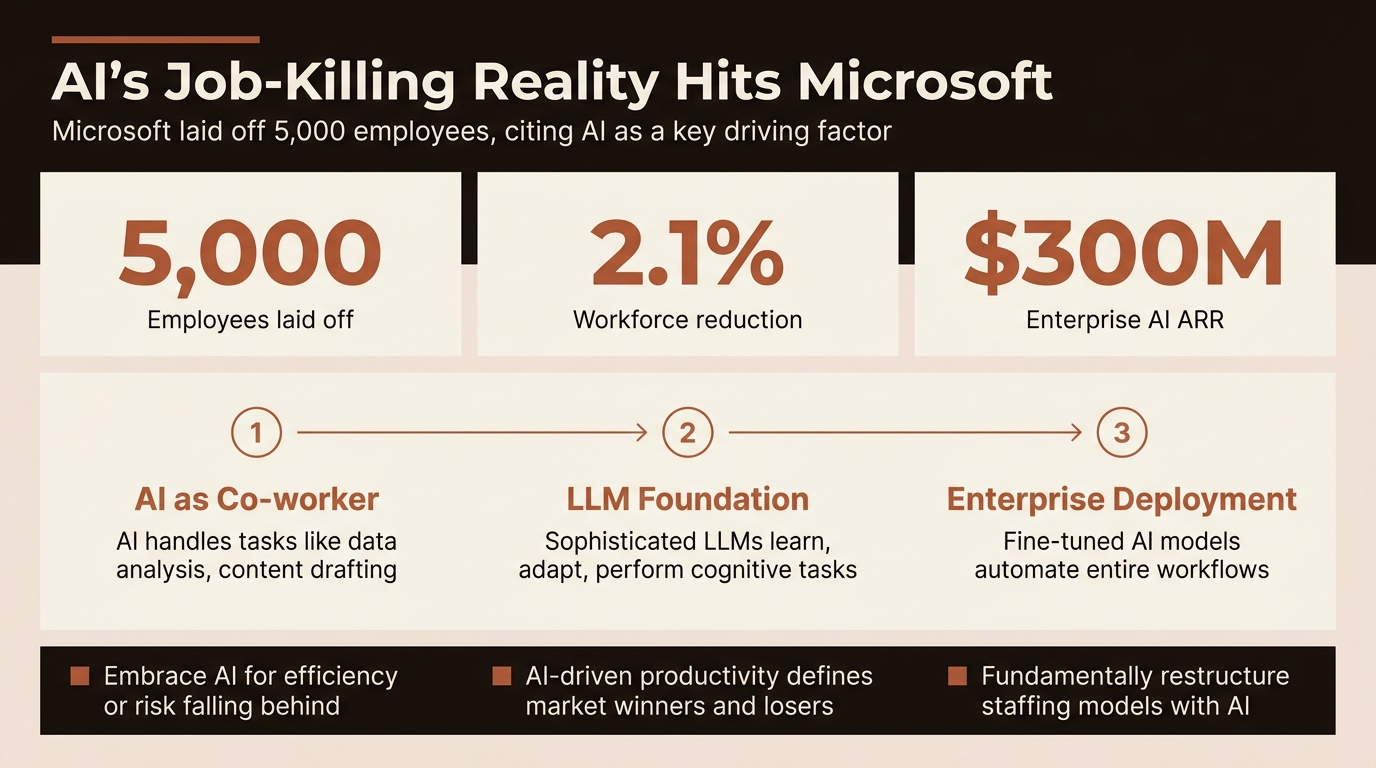
The tech world just got a gut punch. Microsoft, a titan of industry, laid off nearly 5,000 employees this week. This staggering figure represents 2.1% of its global workforce, a move that reverberated from Xbox divisions to commercial sales teams. This is not an isolated incident; it is the latest, and perhaps most chilling, in a series of major tech layoffs where Artificial Intelligence is explicitly named as a driving factor. The implications are enormous.
For years, we heard whispers of AI automating jobs. Now, it is happening at scale, with one of the world’s most valuable companies leading the charge. Executives are re-allocating resources, shifting investment from human capital in certain departments to aggressive AI development and deployment. This strategic pivot signals a new era, one where even highly skilled positions are vulnerable to intelligent automation. This isn’t just about trimming fat; it is a fundamental restructuring of how a global enterprise operates.
The immediate impact is clear: thousands of families are affected. The broader message is even starker: the AI revolution is here, and it is reshaping the workforce faster than anyone predicted. This move by Microsoft is not merely a corporate decision; it is a bellwether, a stark warning for every company and every professional worldwide. Get ready, because this is just the beginning of AI’s profound redefinition of work.
Why This Changes Everything
This Microsoft news changes everything for both boardrooms and kitchen tables. For businesses, the message is unambiguous: embrace AI for efficiency, or risk falling behind. Companies that invest heavily in AI tools, automating routine tasks and augmenting complex decision-making, will gain a significant competitive edge. We are seeing companies like Glean, an enterprise AI startup, cross $300 million in Annual Recurring Revenue, demonstrating the massive ROI potential. This means a ruthless focus on AI-driven productivity will define winners and losers in the next market cycle, potentially saving millions in operational costs while boosting innovation.
Conversely, businesses slow to adapt will face immense pressure. Their operational costs will remain higher, their innovation cycles slower, and their market share eroded by AI-powered competitors. This shift is not about minor adjustments; it is about a fundamental re-evaluation of staffing models and strategic investments. The capital saved from these layoffs will likely be funneled directly into AI research, development, and deployment, accelerating the very trend that caused the job cuts in the first place.
For the everyday person, this is a wake-up call. Your job, regardless of industry or perceived security, is now in scope for AI transformation. If your role involves repetitive data entry, content generation, basic customer support, or even certain coding tasks, an AI system is learning to do it faster and cheaper. This isn’t a future problem for your kids; it is a present challenge for your career. Adaptability, continuous learning, and a proactive approach to integrating AI into your skillset are no longer optional. They are the new baseline for professional survival.
Guru’s Education
To understand why Microsoft can shed 5,000 jobs, think of AI as an endlessly patient, hyper-efficient digital co-worker. Instead of hiring dozens of people for tasks like data analysis, content drafting, or even managing complex IT tickets, companies are now deploying sophisticated AI models that can handle these functions with incredible speed and accuracy. These aren’t just glorified macros; they are intelligent systems that learn, adapt, and perform cognitive tasks that once required human input.
Under the hood, this involves powerful Large Language Models, or LLMs, similar to the technology behind ChatGPT or Google’s Gemini. These models are trained on colossal datasets, enabling them to understand, generate, and process human-like text and data. Companies then fine-tune these general models using techniques like LoRA, or Low-Rank Adaptation, to specialize them for specific enterprise tasks. This allows for highly efficient deployment and customization without the enormous computational cost of retraining an entire foundational model. Tether AI recently announced breakthroughs in this ‘Stable Intelligence layer,’ making such deployments even more accessible.
So, when Microsoft talks about AI efficiencies, they are talking about tools like GitHub Copilot writing code for developers, or advanced AI agents automating support queries, or even optimizing internal operations with predictive analytics. These systems are not just assisting humans; they are increasingly taking over entire workflows. You now know that AI isn’t just a chatbot; it is a strategic enterprise asset capable of fundamentally reshaping job functions and organizational structures. This knowledge puts you ahead of 95% of people still thinking AI is just a gimmick.
The Guru’s Take
*Here is what nobody is telling you: these Microsoft layoffs are not merely about cost-cutting; they are a calculated, strategic acceleration into an AI-first operating model. After 25 years building enterprise systems, from Salesforce implementations to massive cloud migrations, I have seen this pattern before. Companies like Microsoft are not just replacing humans with AI; they are fundamentally redefining the value of human labor. They are shifting capital from ‘doing’ roles to ‘directing AI’ roles, and the sheer pace is unprecedented.
My boldest prediction is this: the next 18 months will see an unprecedented wave of white-collar job displacement, far surpassing anything we witnessed during the dot-com bust or the 2008 recession. Entire departments will shrink. Roles in marketing, customer service, middle management, and even certain software development will be fundamentally reshaped, with AI handling 80% of the workload. The winners will be companies like NVIDIA, OpenAI, and yes, Microsoft, who are building these foundational AI capabilities. The losers will be the organizations, and individuals, who cling to old ways of working.
This isn’t a theory; it is a battle plan unfolding in real-time. The action you must take THIS WEEK is simple, yet critical: identify the 20% of your current job tasks that an AI could perform. Then, commit to learning how to prompt, manage, and leverage AI tools to automate those tasks yourself. Become the expert who directs the AI, not the one whose job gets directed away. Your career depends on becoming an AI-augmented professional, not an AI-replaced statistic. Share this with everyone you know; it is that important.*