The News
OpenAI just unleashed Astra, their latest AI model, and the industry is reeling. This is not just another incremental update; Astra represents a seismic shift towards truly multimodal, real-time intelligence. The company claims it is their most powerful and capable model yet, capable of processing and responding to audio, video, and text inputs with unprecedented speed and accuracy. This means an AI can now see what you see, hear what you hear, and converse with you in real time, blurring the lines between human and machine interaction.
The ‘controversial’ tag stems from its potential. Imagine an AI that can diagnose a complex machinery issue by simply watching a video feed, then guide a technician verbally through the repair process, all in seconds. This level of pervasive, context-aware AI raises immediate questions about data privacy, ethical use, and the very nature of work. OpenAI is clearly pushing the boundaries, forcing competitors like Google and Meta to accelerate their own multimodal research or risk being left behind in a rapidly evolving landscape.
This launch is not just a technical marvel; it is a strategic declaration. OpenAI is signaling its intent to dominate the next generation of AI applications, moving beyond text generation to become the foundational layer for all sensory intelligence. The implications for every industry, from healthcare to manufacturing to customer experience, are profound. Prepare for a future where your digital assistant is not just smart, but truly aware, integrated into every facet of your operational workflow.
Why This Changes Everything
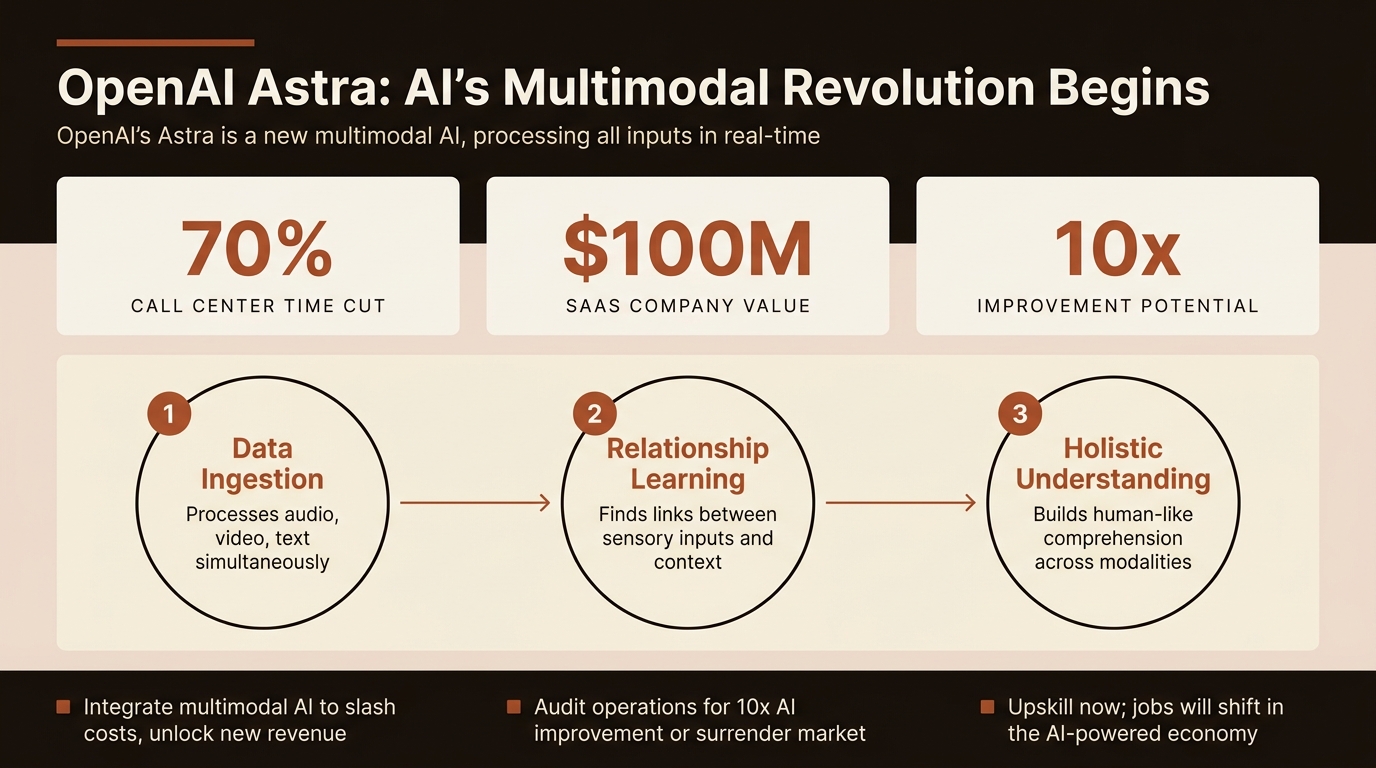
This isn’t just a fancy tech demo; Astra changes everything for enterprise revenue and competitive advantage. Businesses currently spend billions on customer support, field service, and data analysis. Imagine an Astra-powered system reducing call center times by 70%, identifying critical equipment failures before they happen, or personalizing marketing campaigns based on real-time visual cues from a user’s environment. Companies that integrate this level of multimodal intelligence will gain an insurmountable lead, slashing operational costs and unlocking entirely new revenue streams that were previously unimaginable. The laggards will face obsolescence, outmaneuvered by competitors leveraging AI that can literally see and hear their market.
For the everyday person, this means a radical transformation of our digital and physical lives. Your smart home assistant will no longer just respond to voice commands; it will anticipate your needs by observing your actions. Your car will not just drive; it will act as a true co-pilot, interpreting complex road situations and interacting naturally. Jobs requiring repetitive visual inspection, audio transcription, or even basic diagnostic skills are now on the clock. While this creates new roles in AI oversight and prompt engineering, the immediate impact for millions will be a re-evaluation of their core competencies. This shift demands a proactive approach to skill development, or you risk being left behind in the AI-powered economy.
The ripple effect will hit every sector. Salesforce, a company I spent years with, will need to rapidly integrate these multimodal capabilities to stay relevant, moving from data-driven CRM to ‘context-aware’ CRM. Every $100 million enterprise SaaS company will face pressure to embed Astra-like intelligence into their offerings, or their value proposition will erode. This is not a distant future; it is the immediate present. Businesses must audit their entire value chain this quarter to identify where multimodal AI can deliver a 10x improvement, or they will surrender market share.
Guru’s Education
To understand Astra, think of it less as a chatbot and more like a digital expert with all five senses. Imagine you are trying to fix a leaky faucet. Instead of typing your problem into a search bar, you simply point your phone camera at the sink and describe the issue out loud. Astra instantly ‘sees’ the drip, ‘hears’ your explanation, and ‘understands’ the context. It is like having a master plumber, fluent in every language, instantly available and perfectly attentive. This is the power of multimodal AI, integrating different data types to build a holistic understanding.
Under the hood, this magic happens through a sophisticated neural network architecture. Previous AI models typically specialized in one domain: large language models for text, computer vision models for images, or speech recognition for audio. Astra breaks this silo. It employs a unified architecture, often called a ‘transformer’ or similar, that can ingest and process all these data types simultaneously. The model learns to find relationships between what it sees, hears, and reads. For example, it might learn that the sound of a ‘drip’ often co-occurs with the visual of ‘water leaking’ and the text ‘faucet repair’. This cross-modal learning allows for a much richer, more human-like comprehension.
This integrated approach is what makes Astra so powerful. Instead of needing separate AI systems for Siri’s voice recognition, Google Photos’ image search, and ChatGPT’s text generation, you get one cohesive intelligence. It is about creating a single ‘brain’ that processes the world through multiple sensory inputs, just like you do. This unified understanding allows for incredibly nuanced responses and problem-solving, far beyond what any single-modality AI could achieve. You now know why this is a game-changer; it is the closest we have come to artificial general intelligence, operating across diverse sensory landscapes.
The Guru’s Take
*Here is what nobody is telling you: Astra is not just a product release; it is the opening salvo in the ‘AI Operating System’ wars. For years, we have built applications on top of operating systems like Windows, iOS, or Android. Now, AI models like Astra are becoming the new operating system, the foundational layer that understands and interacts with the world. The company that controls this multimodal AI OS will control the future of computing, just as Microsoft and Apple once did. Expect fierce competition, strategic acquisitions, and a land grab for talent and data on an unprecedented scale. This is about establishing a new paradigm, not just selling another API.
After 25 years building enterprise systems, I have seen this pattern before: a foundational technology emerges, and those who adapt early define the next decade. Think of the shift from on-premise to cloud with AWS and Azure, or the mobile revolution led by Apple and Google. Companies that failed to embrace cloud computing lost billions in market capitalization. Those who ignore multimodal AI will face a similar fate. Salesforce, Microsoft, and Google are all in this race, but OpenAI, with Astra, has just thrown down a gauntlet that demands immediate response. The enterprise software giants must rapidly integrate, or they risk being relegated to legacy status.
Your concrete action this week: Do not just read about Astra; experience it. Find a demo, watch videos, and critically, convene your executive team. Identify three mission-critical business processes that rely on human interpretation of visual or auditory data. Challenge your teams to prototype an Astra-like AI solution for just one of them. This is not about a five-year plan; it is about a 90-day sprint to understand, adapt, and integrate this new intelligence. The future of your company depends on how quickly you move from curiosity to concrete action. The clock is ticking, and the AI OS war has just begun.*