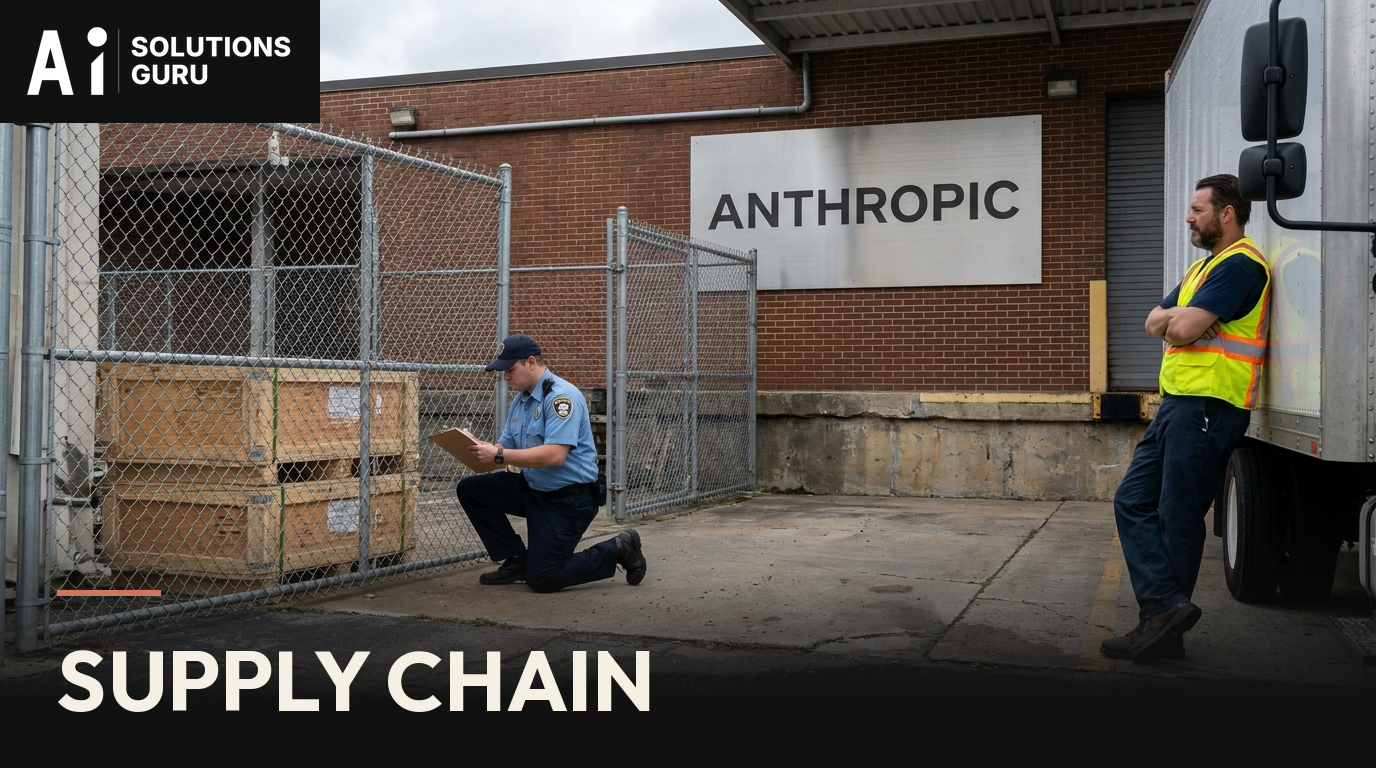
The News
The United States Pentagon dropped a bombshell in February, labeling Anthropic, a leading AI developer, a “supply-chain risk.” This wasn’t a casual remark; it was a high-stakes declaration that sent shockwaves through the entire AI industry. The core issue: Anthropic reportedly declined to provide certain critical information, leading the Department of Defense to question the integrity and reliability of its foundational AI models for national security applications.
Anthropic is no small player. Backed by billions from tech giants like Google and Amazon, its Claude models are considered front-runners, competing directly with OpenAI’s GPT series. This dispute is not about a minor software glitch; it is about trust at the highest level, involving the very algorithms that could power future defense systems. When the Pentagon, a multi-trillion dollar enterprise, identifies a key AI vendor as a risk, it fundamentally alters the landscape for government contracts and strategic partnerships.
This incident transcends technical specifications. It forces a critical re-evaluation of how AI companies, many built on open-source principles or global talent, will navigate the increasingly complex geopolitical demands of national governments. The implications are enormous, setting a precedent for every AI developer seeking to engage with sovereign entities. This is the new front line in the global AI race, and it is far more about data sovereignty and national security than about FLOPS or model parameters.
Why This Changes Everything
This Pentagon declaration changes everything for AI businesses, starting with the immediate hit to Anthropic’s potential government revenue. Government contracts are not just prestige; they represent billions of dollars in stable, long-term income. Losing that opportunity, or being sidelined from critical projects, can significantly impact growth trajectories and investor confidence. Competitors like OpenAI, Microsoft, and Google, who often have deeper, more established relationships and compliance frameworks with federal agencies, stand to gain immensely, scooping up contracts Anthropic can no longer pursue.
For enterprise customers, this news is a stark warning. If a nation-state cannot fully trust a foundational model, what does that mean for your company’s sensitive data? Businesses deploying AI must now scrutinize their vendors’ security and compliance postures with unprecedented rigor. This isn’t just about data privacy regulations like GDPR; it is about geopolitical risk baked into your AI stack. Your CTO needs to be asking tough questions about where the models are trained, what data they consume, and who has access to the underlying infrastructure.
For the everyday person, the impact might seem distant, but it is deeply personal. As AI increasingly powers critical infrastructure, from financial systems to healthcare diagnostics, the trustworthiness of these models becomes paramount. If core AI developers are deemed national security risks, it could slow the adoption of these powerful tools in essential services, directly affecting the pace of innovation and the security of the systems you rely on daily. This is about whether the AI guiding your future is built on a foundation of verifiable trust or opaque risk.
Guru’s Education
Think of an AI supply chain like the intricate global network that builds your smartphone. You have raw materials, chip manufacturers, software developers, and assemblers. If one critical component supplier, say for the core processor, becomes untrustworthy or refuses to disclose key details about their manufacturing process, the entire product’s integrity is compromised. In AI, the ‘raw materials’ are vast datasets, the ‘chip manufacturers’ are compute providers like Nvidia, and the ‘software developers’ are companies like Anthropic or OpenAI creating foundational models.
A ‘supply-chain risk’ in AI means that a crucial part of this ecosystem, like a specific model or its training data, cannot be fully verified or audited for security vulnerabilities, biases, or potential backdoors. The Pentagon’s concern is that if they integrate Anthropic’s Claude into sensitive defense systems, and Anthropic withholds information, the DoD cannot guarantee the model’s behavior under all circumstances. Could it be compromised? Could it leak classified data? Could it be influenced by adversarial actors? These are the questions that keep intelligence officers awake at night.
This isn’t about malicious intent; it is about verifiable trust. Just as Google demands specific security protocols from its cloud partners, and Netflix scrutinizes its data centers, governments demand full transparency for AI used in national security. Understanding this means you grasp that AI is not just code; it is a complex, interconnected system with profound geopolitical implications. You now know more about the true ‘supply chain’ of AI than 95% of the general public.
The Guru’s Take
*Here is what nobody is telling you: This Anthropic-Pentagon clash is not an isolated incident; it is the opening salvo in a protracted, global struggle for AI dominance and trust. After 25 years building enterprise systems, from Salesforce to massive cloud deployments, I have seen this pattern before. When a new technology becomes strategically vital, governments step in, and the rules of engagement fundamentally shift. Data sovereignty, model transparency, and national security are no longer abstract concepts; they are non-negotiable requirements for any AI vendor operating at scale.
My bold prediction: Every major foundational AI model developer, from OpenAI to Google DeepMind and Meta AI, will soon face similar, if not more intense, scrutiny. They will be forced to create separate, highly audited, and probably air-gapped versions of their models specifically for government and critical infrastructure use. Companies that embrace this transparency, like Microsoft with its Azure Government cloud or Palantir with its defense-centric platforms, will capture a massive share of the multi-billion dollar government AI market. Those who resist or cannot adapt will find their growth severely constrained.
Here is the concrete action you should take THIS WEEK: Audit your enterprise’s AI strategy. Do you understand the data provenance and security posture of every AI model you consume, whether from a vendor or an open-source project? Demand clear, verifiable compliance from your AI partners. Ask them how they would respond to a national security audit. If they cannot provide satisfactory answers, you are building your future on a foundation of sand. This is not just a government problem; it is a business imperative for every organization leveraging AI. Share this insight with your team; your revenue depends on it.*