The News
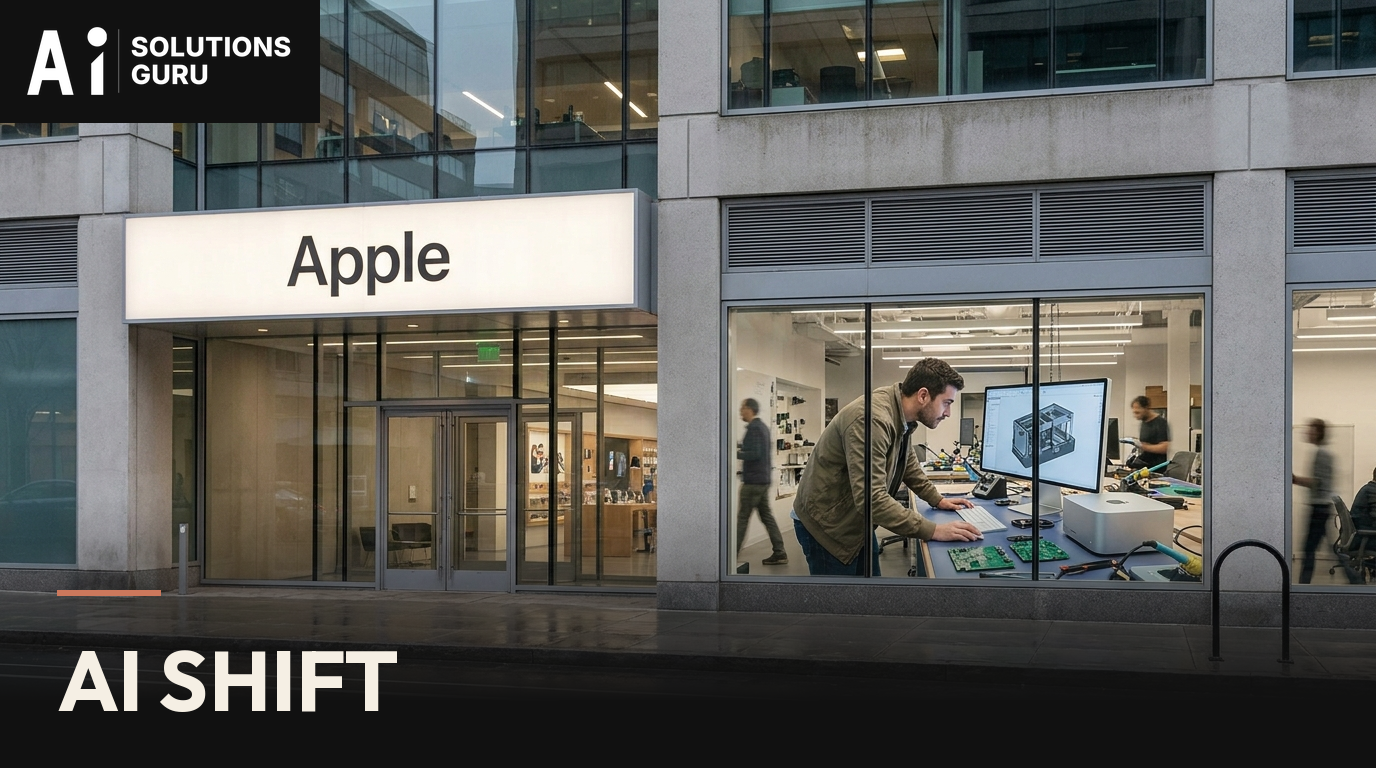
The biggest tech story this week isn’t a new chatbot or a metaverse stunt. It is Apple, quietly but decisively, shifting the entire AI computing paradigm. Their latest desktop computers are engineered specifically for local AI inference. This isn’t just about faster M-series chips; it is a strategic declaration that changes the game for every enterprise and developer.
Apple’s release notes confirm the integration of Thunderbolt 5, enabling “low-latency communication between Thunderbolt 5 hosts for use cases including distributed AI inference.” This means your Mac is no longer just a terminal to the cloud; it is a powerful, private AI data center on your desk. This move challenges the fundamental assumption that all serious AI workloads must live in hyperscale data centers like AWS or Azure.
This is not a minor upgrade. It is a calculated, multi-billion dollar investment in on-device intelligence. The implications for privacy, speed, and operational costs are staggering. Forget waiting for server responses; your AI models can now run locally, instantly, without a single byte leaving your control. This isn’t just about Apple’s ecosystem; it is a clear signal of where the entire industry is heading, and you need to pay attention.
Why This Changes Everything
This seismic shift to local AI changes everything for businesses, from startups to Fortune 500 giants. Who wins? Companies prioritizing data privacy, healthcare providers, financial institutions, and any enterprise with sensitive customer data. They can now deploy powerful AI models without the inherent risks of cloud data transfer. Developers building on-device experiences will see their applications become faster, more responsive, and inherently more secure, unlocking entirely new product categories.
Who loses? Pure-play cloud AI providers who rely solely on remote inference. While the cloud will always have a role for massive training tasks, a significant chunk of inference revenue could migrate to the edge. Businesses that cling to an exclusively cloud-centric AI strategy will face higher latency, increased data transfer costs, and mounting privacy concerns. Your competitive advantage hinges on adapting to this hybrid reality, immediately.
For the everyday person, this means a new era of AI that is truly personal. Imagine a Siri that understands your complex queries instantly, without sending your voice to Apple’s servers. Think about AI-powered photo editing, video rendering, or real-time language translation happening on your device with zero lag. Your personal data stays on your device, enhancing privacy and trust. This isn’t just convenience; it is a fundamental shift in how we interact with technology, making AI feel less like a remote service and more like a native extension of our digital lives.
Guru’s Education
To understand this shift, think of it like this: Cloud AI is a massive, central kitchen serving millions of customers. It is powerful but has latency, and everyone’s orders mix. Local AI, powered by Apple’s new chips, is your personal chef, cooking right in your kitchen. It is faster, more private, and perfectly tailored to your needs, without ever sending your ingredients out.
Under the hood, Apple is leveraging its custom Silicon, specifically the Neural Engine, which is a dedicated hardware accelerator for machine learning tasks. These chips are designed for incredible efficiency and speed when running AI models. The real kicker here is Thunderbolt 5. This technology allows multiple devices, like several Macs or external GPU enclosures, to communicate at incredibly high speeds, effectively creating a distributed AI inference cluster right on your desktop. Your Mac can now act as a powerful, private AI server.
This means AI models, whether they are large language models for text generation or sophisticated vision models for image analysis, can execute directly on your hardware. No more API calls to ChatGPT’s servers for every query. No more uploading sensitive medical images to Google Cloud for analysis. The processing happens where the data lives: on your device. Now you understand why this is a game-changer; you know more about the future of AI computing than 95% of the industry.
The Guru’s Take
*Here is what nobody is telling you: Apple’s move isn’t just about selling more Macs. After 25 years building enterprise systems from Salesforce to hyperscale clouds, I have seen this pattern before. The pendulum always swings. We went from centralized mainframes to decentralized PCs, then back to centralized cloud computing. Now, we are entering the era of hybrid AI, where the most valuable inference happens at the edge.
My boldest prediction is this: Every major chipmaker and operating system vendor will be forced to follow Apple’s lead. Qualcomm, Intel, and even Nvidia will double down on edge AI capabilities. Companies that fail to optimize their AI models for on-device deployment will be left behind, facing higher operational costs and losing the trust of privacy-conscious customers. This isn’t a niche trend; it is the next frontier of computing.
Your concrete action this week: Immediately audit your existing AI workloads. Identify tasks that can benefit from local inference due to latency, cost, or privacy requirements. Start experimenting with open-source, on-device large language models or computer vision frameworks. For developers, dive deep into Apple’s Core ML or similar edge AI SDKs. The future of AI is not just in the cloud; it is in your hands, on your desk, right now. Don’t scroll past this opportunity.*