The News
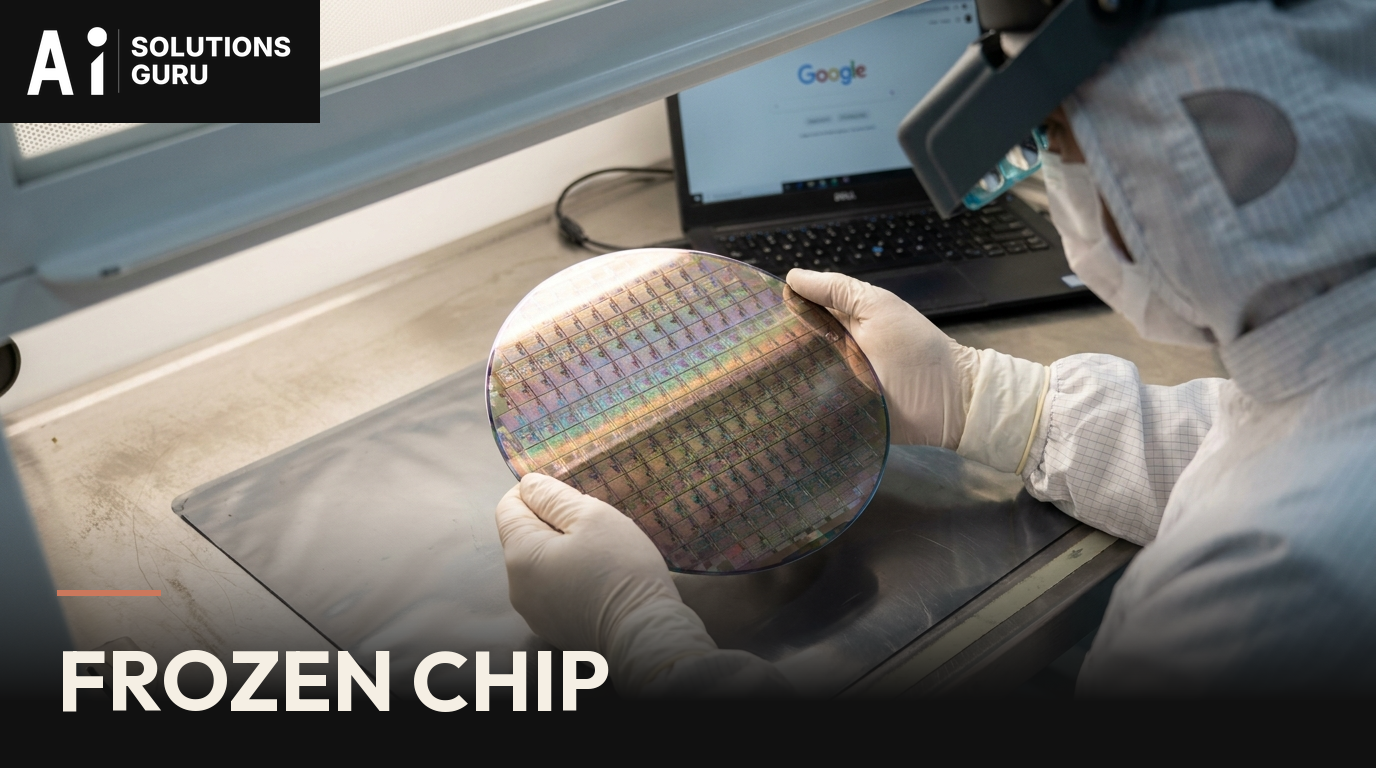
Google just dropped a bombshell that will reshape AI infrastructure for the next decade. They are developing a revolutionary new server chip, internally dubbed ‘Frozen,’ designed to directly embed the architecture of their foundational Gemini AI model. This is not just another custom accelerator; this is a radical hardware-software co-design, a move to hardwire their most advanced AI into the silicon itself. Imagine Gemini running with unprecedented efficiency, speed, and at a fraction of today’s operational cost. This is Google’s endgame for controlling the entire AI stack, from research to silicon to deployment.
This isn’t a future vision; it is happening now. Sources indicate this ‘Frozen’ chip integrates Gemini’s blueprint, allowing Google to serve its AI models with a level of optimization previously deemed impossible. This move directly addresses the escalating compute costs that plague large language model inference. When you consider the billions of dollars Google invests in AI research and development, a technology that could cut inference costs by 50% or more fundamentally alters their competitive landscape. It ensures Google can scale its AI ambitions without being throttled by hardware bottlenecks or exorbitant per-query expenses.
The implications are staggering. This strategic play allows Google to double down on its AI leadership, offering superior performance and potentially lower costs to its cloud customers. It’s a direct response to the market dominance of Nvidia’s GPUs and a bold statement about vertical integration. This development sets the stage for a new era of AI where specialized hardware becomes the ultimate differentiator, promising a future where AI models are not just software, but living entities etched into the very fabric of computing.
Why This Changes Everything
This news changes everything for businesses relying on, or planning to rely on, large-scale AI. For companies currently renting GPU compute from AWS, Azure, or Google Cloud, this signals a future where Google Cloud could offer dramatically more cost-effective inference for Gemini-powered applications. Imagine running complex AI tasks for pennies on the dollar compared to current rates. This directly impacts your budget, your ability to innovate, and your competitive edge. Businesses that can leverage Google’s optimized stack will gain a significant advantage, potentially outperforming rivals still wrestling with generic hardware and higher operational expenditures.
Who wins? Google, unequivocally. And by extension, businesses deeply integrated into the Google Cloud ecosystem, especially those building applications on Gemini. Who loses? Potentially, companies heavily invested in other cloud providers or those solely reliant on general-purpose GPU architectures for massive inference workloads. This could force a re-evaluation of multi-cloud strategies and infrastructure choices across the board. If Google can deliver on the promised efficiency gains, we are talking about billions of dollars shifting in the compute market, impacting everything from startup burn rates to enterprise-level digital transformation initiatives.
For the everyday person, this means a faster, more intelligent, and potentially cheaper interaction with AI-powered services. Think about your Google Search queries, your interactions with Gemini directly, or any application powered by Google’s AI. Faster responses, more accurate results, and seamless integration into your daily life. For those in tech, this is a wake-up call. Your job in AI development or infrastructure just got a new dimension: understanding hardware-software co-design and the strategic implications of vertical integration. Ignoring this seismic shift is no longer an option.
Guru’s Education
To understand Google’s ‘Frozen’ chip, think of it like this: your car’s engine is designed to run on a specific type of fuel for optimal performance. Now, imagine if the engine itself was custom-built around that specific fuel, making it incredibly efficient and powerful, far beyond what any generic engine could achieve. That is what Google is doing with Gemini and its new chip. Instead of running a complex AI model like Gemini on a general-purpose GPU, which is like putting rocket fuel in a standard car engine, they are building an engine specifically designed for Gemini’s ‘fuel’, its unique computational graph and algorithms.
Under the hood, this involves deeply integrating the neural network architecture of Gemini directly into the silicon. Traditional chips are generalists; they can compute many things. But an AI model has a very specific set of operations it needs to perform, repeatedly and at scale: matrix multiplications, convolutions, activations. Google’s ‘Frozen’ chip optimizes these specific operations at the hardware level. It means dedicated circuitry for Gemini’s unique layers, custom memory hierarchies tailored to its data flow, and specialized execution units that perform Gemini’s calculations with unparalleled speed and energy efficiency. It is a bespoke suit for a superstar AI model.
This is a paradigm shift from software optimization to hardware optimization. Instead of just writing better code for existing chips, Google is designing the chip itself to be the ultimate interpreter of that code. This translates into massive gains in performance and, critically, significant reductions in power consumption per inference. You are seeing the future of AI computing unfold: highly specialized, vertically integrated stacks where the line between hardware and software blurs. Now, you understand why this is a game-changer, putting you ahead of 95% of people still thinking AI is just about algorithms.
The Guru’s Take
*Here is what nobody is telling you: Google’s ‘Frozen’ chip is not just about Gemini; it is Google’s strategic counter-move against Nvidia’s GPU dominance and the escalating costs of AI inference. After 25 years building enterprise systems across Salesforce, cloud, and now GenAI, I have seen this pattern before. Companies that control the full stack, from silicon to software to service, always win in the long run. Apple does it with its M-series chips, Tesla does it with its FSD hardware. Google is now applying this playbook to AI, and it is a masterstroke.
This move signals a new phase in the AI arms race, shifting from who has the best model to who has the most efficient infrastructure to run those models. Expect other tech giants like Microsoft and Amazon to accelerate their own custom AI chip initiatives, if they are not already. The era of buying off-the-shelf GPUs for massive AI inference is rapidly drawing to a close for the hyperscalers. This will lead to increased competition, potentially driving down costs for end-users, but also creating a fragmented hardware landscape where optimized proprietary stacks deliver superior performance.
My boldest prediction: within three years, the cost of running frontier AI models will drop by 70% for companies leveraging custom silicon. The winners will be Google, and any enterprise smart enough to align with their vertically integrated AI stack. The losers will be generic cloud compute providers and companies too slow to adapt to this hardware-centric optimization. Your concrete action this week: start researching how Google Cloud’s AI services, specifically those powered by Gemini, can integrate into your existing architecture. Do not wait for the competition to lap you on cost efficiency and performance. This is not a trend; it is the new baseline.*