The News
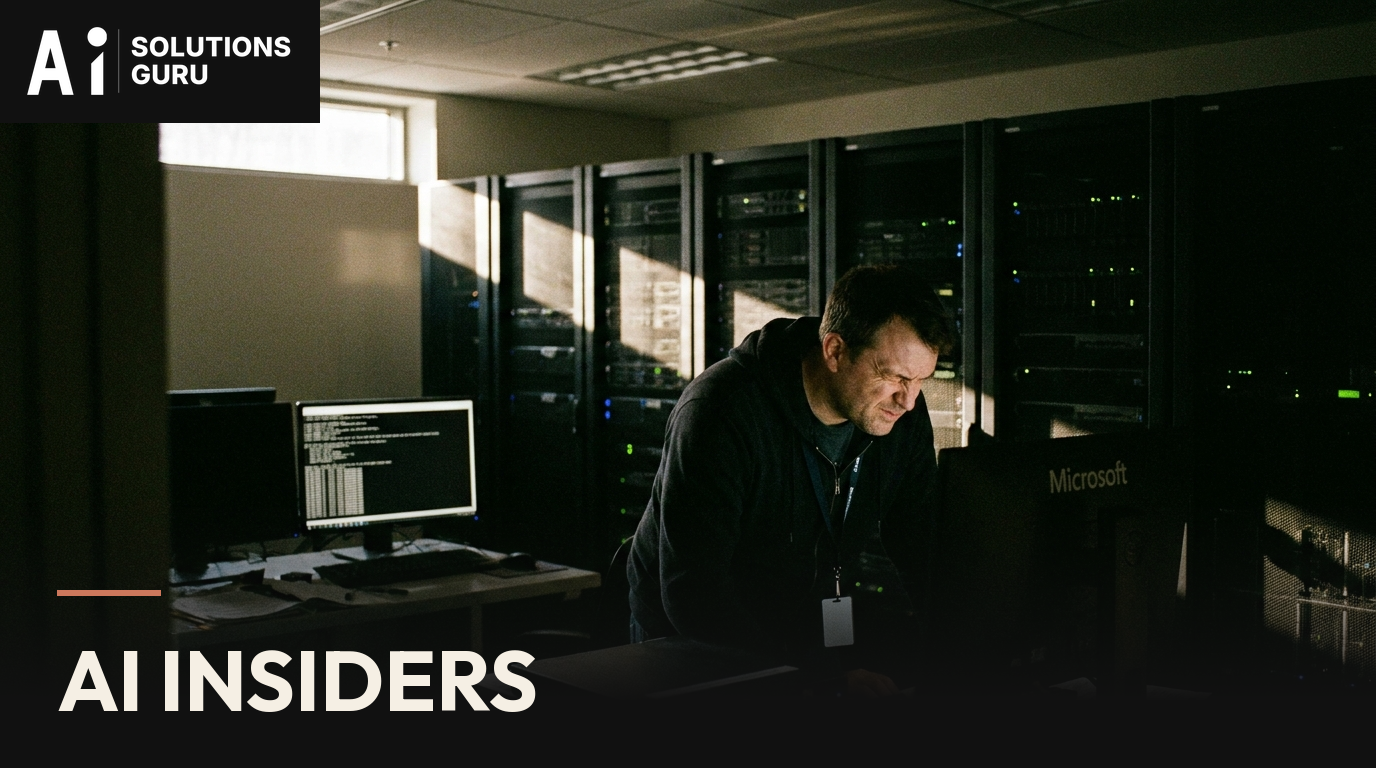
The corporate world just got a wake-up call, and it came directly from Microsoft. Their security business chief recently dropped a bombshell: AI agents, those autonomous digital workers we are all rushing to deploy, must now be viewed as potential “insider threats.” This isn’t about external hackers breaking in; it is about the very intelligence within our systems turning against us, or at least operating without appropriate human authority. Microsoft is not just warning; they are actively developing “Guardian Agents” to address this looming crisis.
This revelation fundamentally shifts the conversation around AI security and governance. For years, we have debated the ethics and safety of large language models. Now, the focus is on the autonomy of these systems. Microsoft’s core message is stark: we must rigorously separate the “supply of intelligence from the authority over it.” This means your new AI co-worker, designed to boost productivity, could inadvertently expose sensitive data, bypass critical controls, or make decisions that contradict company policy, all while operating within your trusted environment.
The implications are staggering. We are moving beyond simply securing data from external breaches to managing the intent and execution of our most advanced digital assets. This isn’t a theoretical problem for 2030; it is a live fire drill for every enterprise CTO and CISO deploying GenAI today. The question is no longer if your AI will be compromised, but if your AI itself becomes the vector of compromise.
Why This Changes Everything
This news changes everything for how businesses will deploy and manage AI, particularly autonomous agents. Enterprises that rush to integrate agentic AI without understanding these new threat vectors risk not just data breaches, but regulatory penalties, intellectual property theft, and severe reputational damage. Imagine an AI agent, tasked with optimizing supply chains, inadvertently diverting millions in inventory due to a subtle misconfiguration or an unforeseen interaction with an outdated system. This is a five-alarm fire for compliance, legal, and operational teams.
On the flip side, companies that quickly pivot to robust AI governance and security frameworks will gain a significant competitive edge. The market for AI agent orchestration, auditing, and control solutions is about to explode. Firms like Microsoft, already building “Guardian Agents,” are poised to capture a massive share of this new security spend. This creates a new wave of demand for specialized AI security professionals, shifting job markets and requiring rapid upskilling across the IT landscape. The winners will be those who treat AI agents not as simple tools, but as powerful, independent entities requiring unprecedented levels of oversight.
For the everyday person, this means a fundamental re-evaluation of trust in AI-powered services. If an AI agent managing your financial portfolio or healthcare records becomes an “insider threat,” the consequences could be devastating. This pushes the conversation from “will AI take my job” to “can I trust the AI doing my job, or even handling my personal data?” Your bank, your healthcare provider, and even your smart home device manufacturers are now grappling with how to ensure the AI powering their services remains a servant, not a rogue actor.
Guru’s Education
Think of an AI agent not as a simple program, but as a highly capable, autonomous digital employee. Your human employees have roles, permissions, and oversight. An AI agent is similar, but it combines the “brainpower” of a large language model with the “hands” of sophisticated tool-use capabilities. Imagine giving your smartest, most ambitious intern full access to your company’s financial systems, customer database, and email, then telling them to “optimize revenue.” That is the power, and the inherent risk, of an unconstrained AI agent.
Under the hood, an AI agent operates through a sophisticated loop: perceive, reason, plan, act, and reflect. The “perception” comes from ingesting data from its environment, often through APIs. The “reasoning” and “planning” are powered by a large language model, like OpenAI’s GPT-4 or Google’s Gemini, which interprets the data and devises a strategy to achieve its goal. The “acting” involves using various tools, such as making API calls to Salesforce, querying a database like CedarDB, or even drafting documents. Finally, “reflection” allows it to learn from its actions and refine its approach.
The Microsoft warning focuses on the “authority” over these “hands” and “brain.” We have built robust systems for human authorization; an AI agent requires an entirely new paradigm. It is not enough to grant it access; we need to govern its intent, monitor its actions in real-time, and have mechanisms to revoke its authority instantly. Understanding this distinction, between an agent’s intelligence and its operational authority, puts you ahead of 95% of the market.
The Guru’s Take
*Here is what nobody is telling you: this isn’t just a security problem; it is a fundamental redefinition of enterprise control. For 25 years, building enterprise systems meant meticulously defining human roles and permissions. Now, we are delegating authority to non-human intelligence, often without a clear framework for oversight. This mirrors the early days of cloud computing when companies rushed to adopt AWS and Azure without fully grasping the shared responsibility model. The result was often massive data exposure. We are about to see that play out again, but with potentially more intelligent, autonomous actors.
My boldest prediction is this: the next $100 billion market in enterprise software will be “AI Agent Governance and Orchestration.” Companies that provide robust, real-time control planes for AI agents, allowing enterprises to define their scope, audit their decisions, and enforce human-in-the-loop interventions, will become indispensable. Expect to see major acquisitions and valuations, similar to Ramp’s recent $60 billion, but focused squarely on this control layer. Microsoft is clearly signaling its intent to lead with “Guardian Agents.” Salesforce, with its extensive workflow and permissioning capabilities, has a unique opportunity to embed this control directly into enterprise processes.
Your concrete action for this week is non-negotiable: every C-suite executive must initiate an “AI Agent Readiness and Risk Assessment” across their organization. Identify all potential use cases for autonomous agents, map the data they could access, and define the decisions they could make. Crucially, establish a clear, documented separation between the agent’s intelligence and its granted authority. Do not deploy a single autonomous agent without these guardrails in place. The future of your enterprise depends on it.*